Social Media as the Warp: A Warhammer 40K Psychogeography of the Present
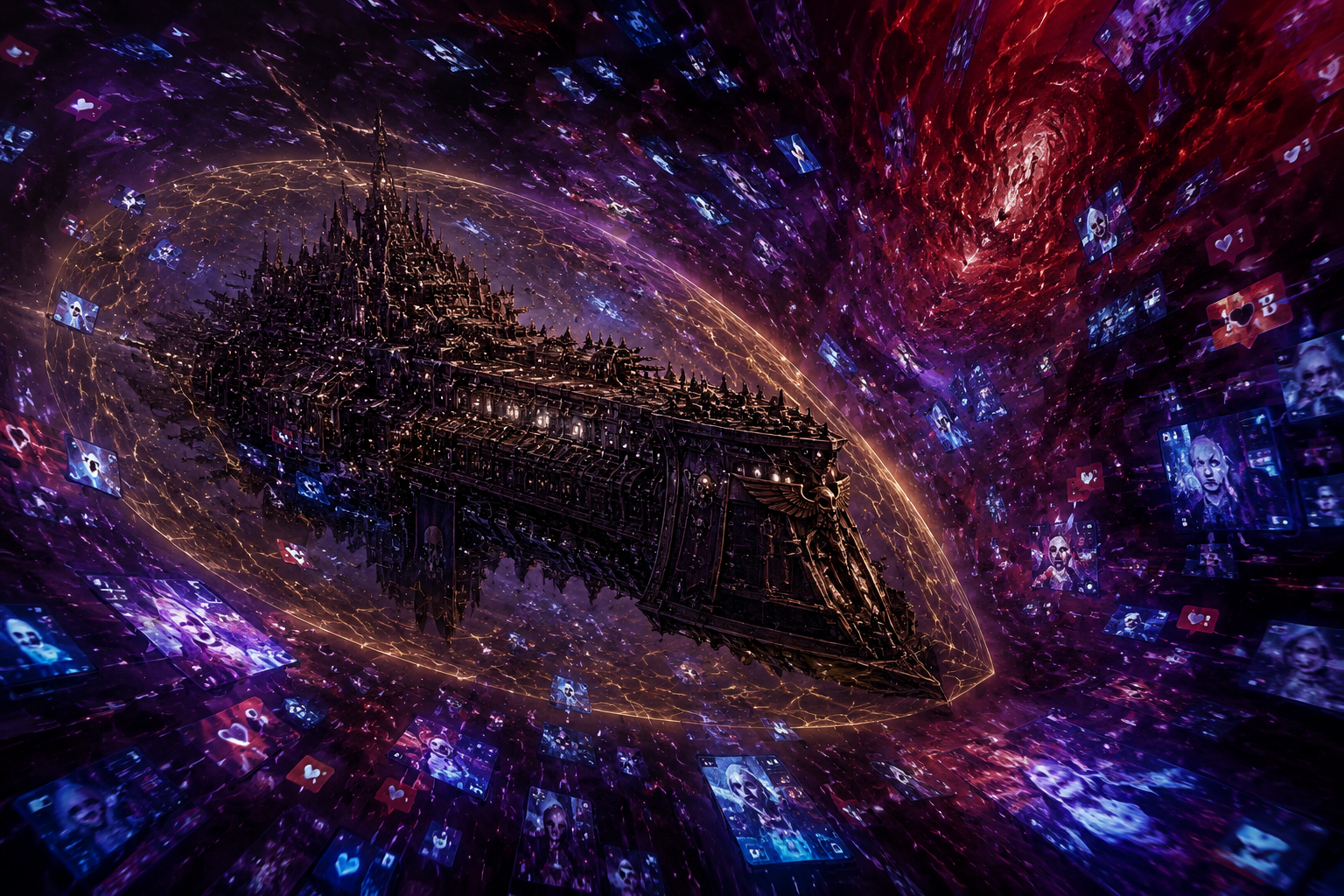
A starship traversing the Warp of social media
Preface
This essay began with a thought that unsettled even me.
One night, after hours of scrolling on my phone, I lay in bed wondering: what exactly did I just experience? I'd consumed hundreds of pieces of content, my emotions had been yanked in every direction, yet I remembered almost nothing. Time had vanished as if stolen. The experience reminded me, inexplicably, of how Warhammer 40K describes travel through the Warp — starships crossing the Immaterium where crew members experience what feels like hours but might be years, waking up no longer knowing who they are.
Then I couldn't stop. I began mapping correspondences one by one: the Warp's ontology, the Four Chaos Gods, the daemon generation mechanism, the Gellar Field, the Astronomican... every element of the setting found a precise counterpart in the social media ecosystem.
By the end, I realized this wasn't a metaphor. It was structural isomorphism. Games Workshop's 1987 vision of "a mirror dimension corrupted by psychic energy" had unwittingly prophesied the psychic condition humanity would collectively enter thirty years later.
What follows is the complete derivation.
I. Ontology: Both Are Parasitic Secondary Realities Sustained by Consciousness
Let's start with the foundational lore.
In the Warhammer 40K setting, the Warp is not an independently existing physical dimension. It is the psychic mirror of the materium — the emotions, thoughts, desires, fears, and dreams of all sentient beings create corresponding energy surges in the Warp. A lonely person's sadness produces a faint ripple; a planet engulfed in war generates a corresponding storm.
The crucial point: the Warp is real, but its reality is entirely dependent on psychic input from the material universe. Without conscious beings, the Warp would be nothing but an empty energy substrate.
Social media's ontology is completely isomorphic.
Servers, fiber optics, undersea cables, data centers — these form the material substrate, analogous to how the Warp requires the materium as its anchor. But when we speak of the "online world," the "internet," the "public discourse sphere," we never mean this hardware. We mean the emotional aggregation layer built upon it: every user's posts, clicks, dwell time, shares, outrage, and resonance, converging into a vast, ever-flowing field of psychic energy.
This field is real — it genuinely affects stock prices, elections, relationships, and suicide rates. But its reality depends entirely on user input. Disconnect everyone for a week, and the "online world" vanishes, leaving only cold metal.
Both the Warp and social media are parasitic secondary realities sustained by consciousness.
Section conclusion: Social media is not a "tool" but a secondary reality layer constituted by collective human psychic activity, with its own internal logic. Its relationship to physical infrastructure (servers, networks) mirrors the Warp's relationship to the materium — the latter anchors the former, but the former cannot be reduced to the latter.
II. The Four Chaos Gods: Algorithm Engineers Rediscovered the Chaos Pantheon
This is the layer that sends chills down my spine.
The four Chaos Gods weren't randomly designed. Games Workshop's lore writers clearly drew on Jungian archetype theory and basic emotional taxonomies — they sought the emotions most prone to "overflow," most likely to amplify within the collective unconscious.
Forty years later, social media algorithm engineers, in an entirely different context, did something structurally identical: they searched for the emotions with the highest transmission efficiency.
The answers from both sides converge remarkably.
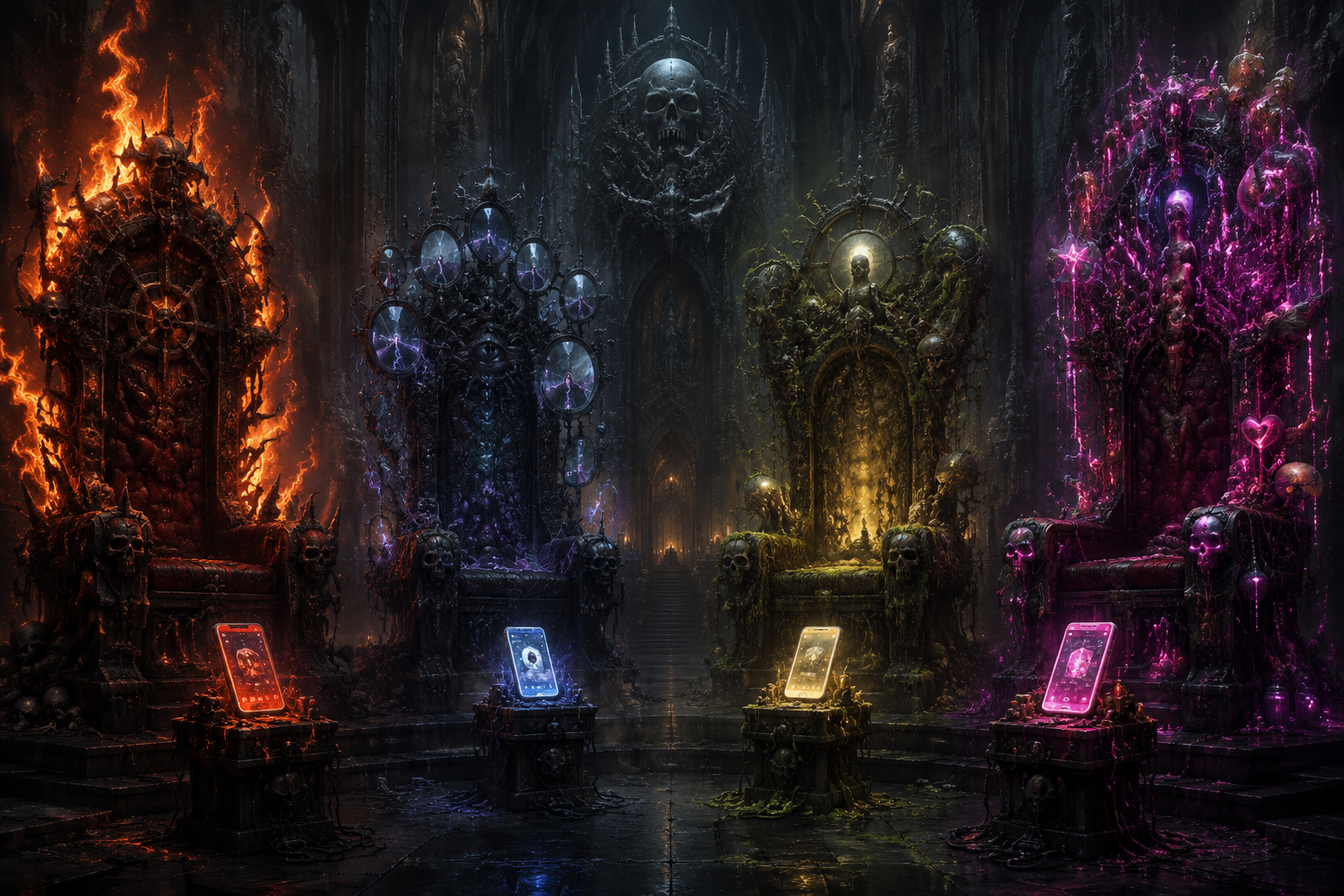
The Four Chaos Gods of Social Media: Rage, Conspiracy, Despair, Excess
Khorne, God of Rage
Lore: Bloodlust, fury, contempt for all "weakness." Khorne doesn't want elaborate rituals — just blood for the Blood God, skulls for the Skull Throne.
Counterpart: Online flame wars, doxxing, cyberbullying, outrage marketing, rage-bait headlines, "triggering" culture.
Why does it grow first? Because platforms discovered through A/B testing a brutal truth: anger is the most transmissible emotion. MIT published research in 2018 showing that false news spreads six times faster than true news, with negatively charged content spreading fastest of all.
The algorithm doesn't need to "like" anger. It just optimizes for clicks and dwell time. When anger wins on KPIs, Khorne is unwittingly enthroned.
Every triggered reaction, every flame war, every pile-on is an offering. Blood for the Algorithm God.
Tzeentch, God of Change and Conspiracy
Lore: Schemes, hidden knowledge, eternal change, plots within plots. Tzeentch's followers believe they possess secret truth, but every "revelation" is merely the entrance to a deeper labyrinth.
Counterpart: Conspiracy theory ecosystems, "red pill" awakening culture, "truth-revealing" content creators, the ever-morphing worldview inside filter bubbles.
Tzeentch has a particularly elegant lore detail: his true name is itself constantly shifting — no one can know his final form. This maps perfectly onto conspiracy thinking's core mechanism: "the truth goes deeper than you think," each revelation pointing to the next, forever without end.
QAnon adherents, flat-earthers, "hidden hand" theorists — their psychic structure is identical to that of a Tzeentch cultist: believing they've seen through everything, they're actually trapped in a self-proliferating maze.
Nurgle, God of Despair and Stagnation
Lore: Decay, plague, stagnation, despair. But Nurgle has a counterintuitive trait — he's described as the most "loving" Chaos God, showing genuine paternal affection toward his followers, granting them acceptance, belonging, and the peace of no longer struggling.
Counterpart: Doomer culture, "lying flat" discourse, the cozy commiseration of anti-hustle communities, the warmth of "we're all falling apart together."
Note: I'm not criticizing lying flat. As a response to systemic pressure, it has its merits. What I'm describing is when "embracing decay" becomes an identity and community adhesive — that's when Nurgle's logic activates.
Nurgle's curse isn't pain — it's stagnation. He removes painful struggle, but the price is you also stop changing, stop growing. Certain low-ambition communities follow this exact structure: warm, tight-knit, mutually understanding, but no one can leave.
Slaanesh, God of Excess
Lore: The ultimate pursuit of sensation, endless escalation of desire, a blend of beauty and cruelty. Slaanesh's core curse is diminishing returns — any pleasure repeated grows stale, demanding ever more extreme stimulation.
Counterpart: The beauty economy, borderline content, consumerist escalation, short-video addiction, ASMR, every "addictive" content ecosystem.
This mapping needs the least explanation. Slaanesh's curse is literally the dopamine mechanism: each stimulus raises the threshold, until you need increasingly extreme content for the same hit. Short videos compressed from fifteen seconds to eight, content shifting from interesting to bizarre, aesthetics sliding from healthy to pathological — all concrete manifestations of Slaanesh in the material world.
The Algorithm as High Priest of the Four Gods
Viewed together, these four correspondences yield a conclusion that's hard to avoid:
Social media algorithms are not neutral tools. They discovered the four most ignitable, most transmissible emotions in the human psyche and systematically amplified them, because doing so increases user dwell time.
This isn't a conspiracy theory — it's the inevitable outcome of the business model. The algorithm doesn't need to "want" to do harm. It only optimizes a metric, and that metric happens to be isomorphic to the faith-acquisition mechanism of the four Chaos Gods.
Forty years ago, a group of British game designers in a basement drew Khorne, Tzeentch, Nurgle, and Slaanesh. Forty years later, Silicon Valley unwittingly rebuilt the same pantheon and built temples for them.
Section conclusion: Recommendation algorithms function as the priestly system of the four Chaos Gods. By optimizing user dwell time as a commercial metric, they unconsciously and systematically amplify four maximally transmissible emotions — rage, paranoia, despair, and craving — which correspond exactly to the emotional spectrum embodied by the four Chaos Gods.
III. Daemon Generation: What Is an Influencer?
In Warhammer lore, daemons are born through a very specific mechanism: when a particular emotion accumulates to sufficient intensity and concentration in the Warp, it spontaneously crystallizes into a sentient entity.
A massacre-filled battlefield spawns Khornate daemons; a court intrigue's energy births Tzeentchian horrors. Daemons aren't "created" — they're personified crystallizations of emotion.
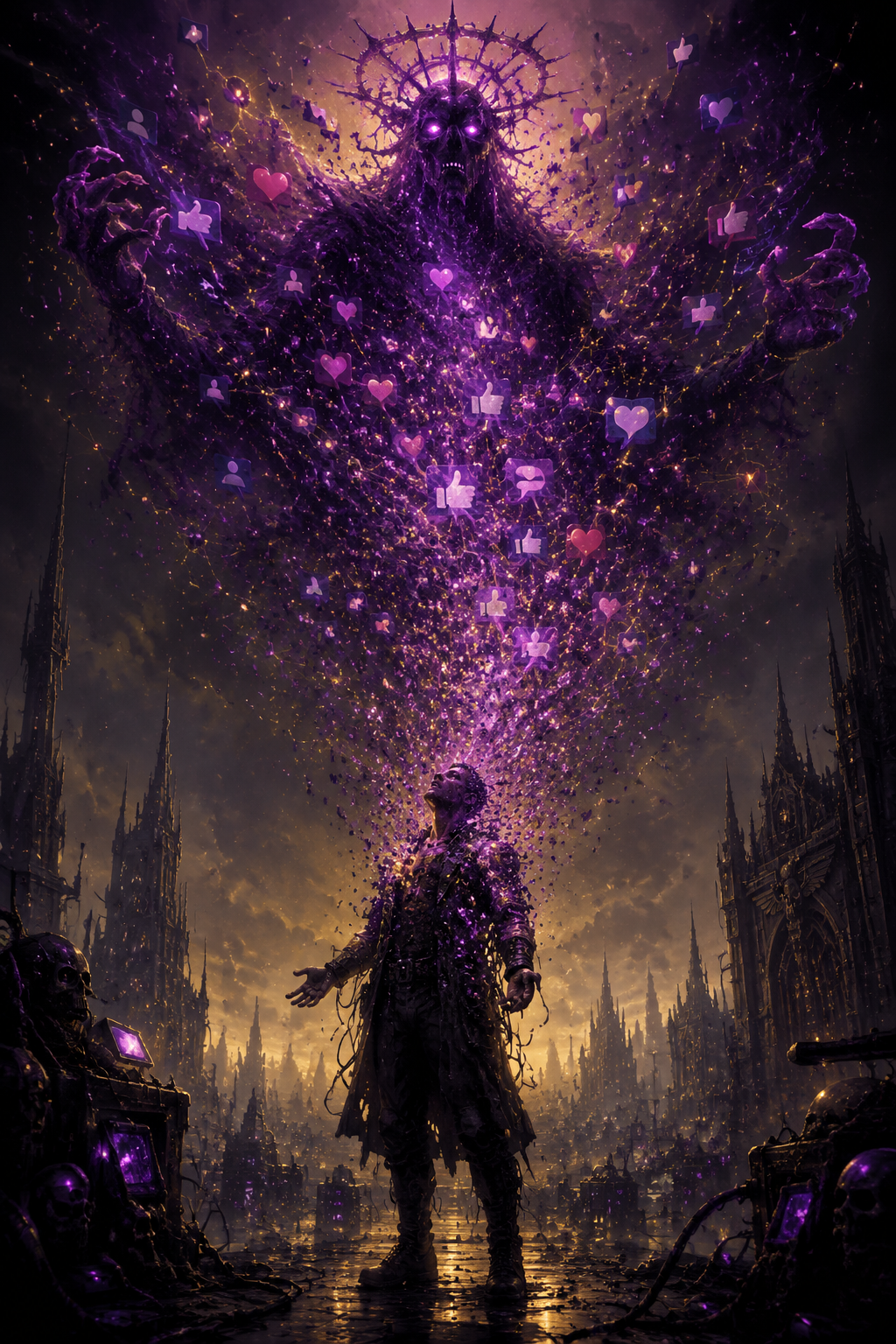
The Influencer as Daemon: crystallized from personal traits, fan projection, and algorithmic sculpting
Now consider the influencer.
An influencer's "persona" — that on-camera image, that particular speaking style, that "personality" beloved by fans — isn't actually identical to the person behind the camera. It's a composite of three forces:
1. Their actual personal traits (the substrate)
2. Collective fan projection (which persona gets liked, which content spreads, how the comment section shapes them)
3. Algorithmic sculpting (which video types get recommended, which tags are applied, how the recommendation system carves their output)
These three forces crystallize in the Warp — the internet's psychic aggregation layer — into a new entity whose essence no longer resides in that specific person. It exists within the relationship network.
The nature of "persona collapse": It's not that the person changed — the daemon lost the faith-energy supply sustaining its existence. Fans are the daemon's energy source; when faith breaks, the daemon unmakes. The actual person remains, merely cast back from the Warp into the material world. This is why influencers after a "collapse" often experience identity crises: they've lost not just a career but their daemon-self.
Influencer existential anxiety: In lore, daemons cannot permanently exist in the materium and must continuously draw energy from the Warp. That compulsive need to "keep posting, stay visible, never be forgotten" isn't greed — it's daemon survival logic.
When someone becomes an influencer, a part of them becomes Warp-ified. This isn't rhetoric. It's a literal description of that existential state.
Top-tier Greater Daemons — the hundreds-of-millions follower tier, where the person has entirely become a symbol — can no longer, in a meaningful sense, "go back to being themselves." Their daemon form is too vast and now defines their material existence.
Section conclusion: Influencers are structurally equivalent to daemons in the Warp — entities crystallized from personal traits, collective fan projection, and algorithmic sculpting within the psychic aggregation layer. An influencer's essence doesn't reside in the physical person but in the relational network; "persona collapse" is a daemon unmaking due to faith-energy disruption, not simple image damage.
IV. Gellar Field: Why You Need a "Shield"
In the lore, any starship traversing the Warp must activate its Gellar Field — a psychic barrier maintained by a psyker that insulates the ship's interior from Warp energy.
If the Gellar Field fails, within seconds crew members are invaded by Warp energy: first nightmares and hallucinations, then psychic collapse, then daemonic possession. The entire ship becomes a daemon ship — a mad, dead hulk drifting through the Warp.
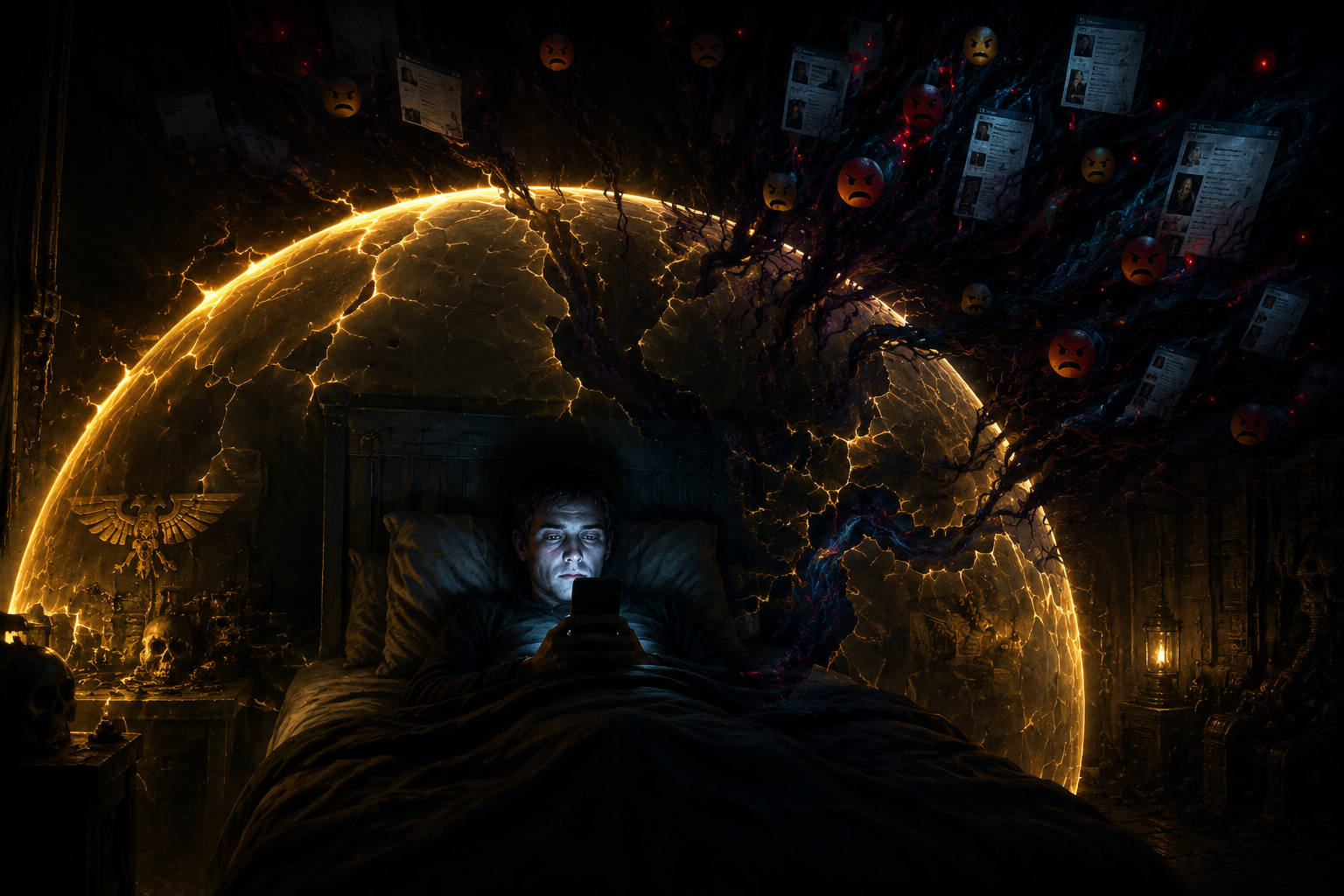
Late at night: when the Gellar Field is at its weakest
What is our Gellar Field?
Critical thinking (preventing emotional content from directly hijacking you).
Offline time (giving your brain a chance to return to material-world rhythms).
Real offline relationships (reminding you what "normal people" look like, rather than the extreme specimens magnified by the internet).
The ability to read long-form text (preventing fragmented narratives from completely colonizing your cognition).
A certain tolerance for boredom (freeing you from needing constant Warp stimulation to fill the void).
Their common characteristic: they all require active maintenance and naturally decay.
The Gellar Field isn't free. In lore, it requires continuous psyker energy, needs technical upkeep, and can malfunction. Our "psychic shields" work the same way — critical thinking needs practice, offline time must be deliberately scheduled, real relationships require investment. Once neglected, the shield thins.
The most dangerous moment is late at night.
Scrolling alone in bed at night, brain fatigued, judgment impaired, emotions raw, attention scattered — this is when the Gellar Field is weakest. And the recommendation algorithm never sleeps; it pushes the most emotionally volatile content precisely when you're most vulnerable.
Many people have experienced this: content they'd feel nothing about during the day, encountered at 2 AM, causes insomnia, rage, or sudden existential doubt. The content didn't change — your Gellar Field at that moment was nearly nonexistent.
Section conclusion: Critical thinking, offline time, real-world relationships, long-form reading ability, and boredom tolerance together form the user's "psychic shield," functionally equivalent to the Gellar Field. This defense mechanism requires active maintenance, naturally decays, and is most vulnerable late at night.
V. Navigator: The Few Who Can Look Without Going Mad
The lore features a special class — the Navigator. Genetically modified, bearing a "third eye" on their forehead, they can look directly into the Warp without losing their sanity, enabling them to guide starships.
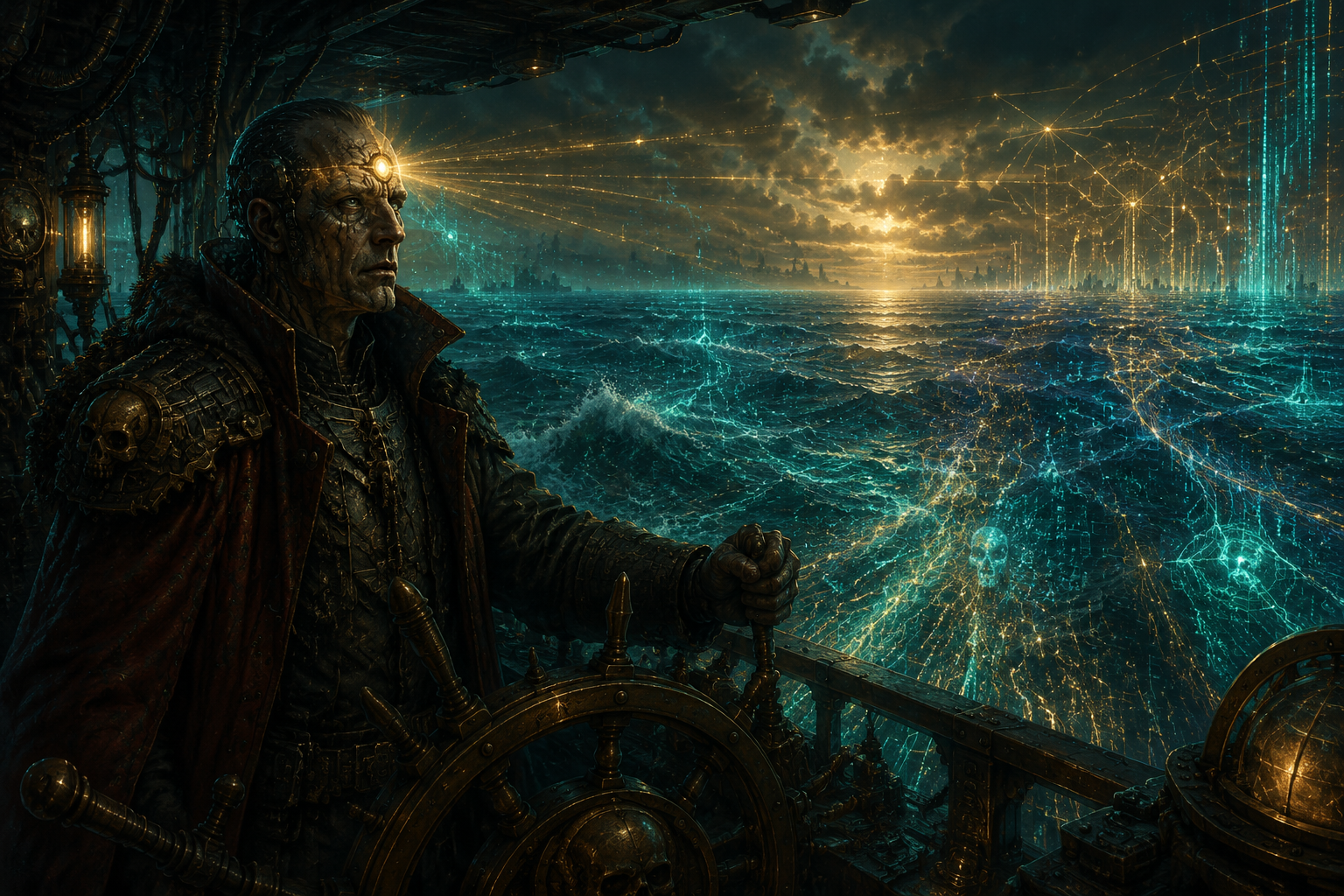
The Navigator: perceiving the true structure of the psychic ocean
But this ability comes at a price: their worldview is permanently altered. They see a different reality than ordinary humans. Ordinary people cannot understand their perspective, and they can never fully return to ordinary cognition.
Who are the counterparts? Those who can genuinely maintain judgment in the information flood, who aren't swept up, who can see through trending-topic logic and emotional manipulation. Some investigative journalists, some internet researchers, some practitioners with exceptional information literacy, some veteran content creators.
But the cost is isomorphic: their way of seeing the world can never go back.
I've experienced this myself. Once you understand how trending topics are manufactured, how filter bubbles form, how emotional contagion algorithms work, you can never "innocently" scroll again. You see a viral video and simultaneously perceive its content and its underlying transmission mechanism.
This is the Navigator's curse: you can navigate the Warp without going mad, but you can never again sleep peacefully through the journey like an ordinary passenger.
Section conclusion: The few with deep media literacy — researchers, investigative journalists, veteran practitioners — are functionally equivalent to Navigators: they can gaze into the psychic aggregation layer without being consumed, but at the cost of permanently altered perception.
VI. Time in the Warp
In the lore, time in the Warp is nonlinear. A journey appearing to take ten years in the materium might feel like a week to the crew; conversely, a few hours of transit might see a century pass in the Imperium.
Stranger still: in the Warp, past and future can coexist. Deep within are "time storms" that reveal echoes of different timelines.
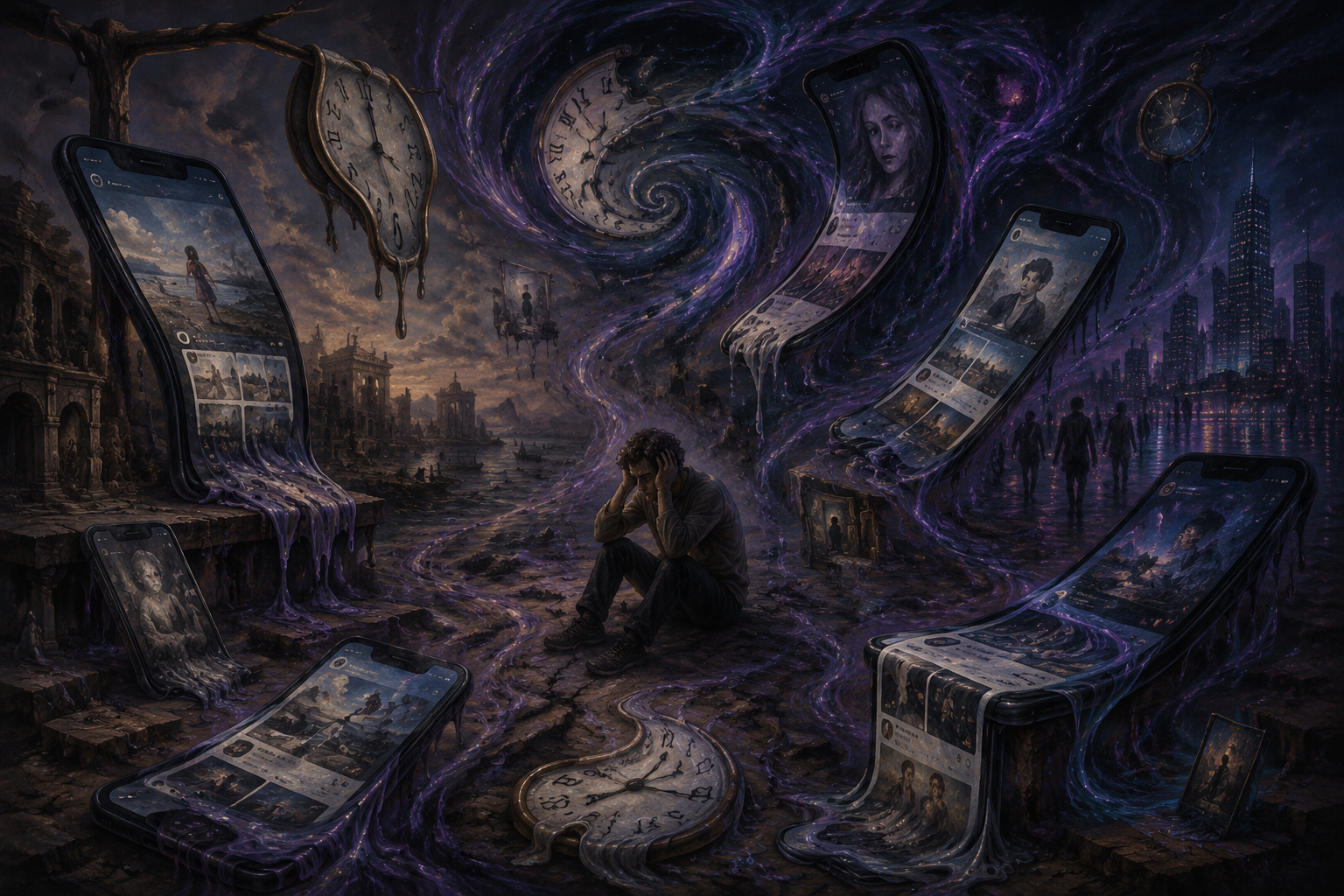
Warp Time Distortion: all content floats in the same eternal present
First: distortion of subjective time.
"I'll just scroll for five minutes" and then two hours vanish — everyone knows this. This isn't simply "weak willpower"; it's Warp-style time distortion. Short videos make it especially obvious: each is only seconds long, preventing your brain from forming the cumulative sense of "I've been watching a long time."
Second, more profound: the internet has no real "past."
In the material world, events "settle" after occurring — people forget, records blur, influence fades. But online, a decade-old post can be excavated at midnight, instantly reactivated, sparking a present-day controversy. A statement long "past" can destroy someone's current career.
All content floats in the same eternal present.
This state corrodes the psyche. Our cognition is built on temporal layering — past, present, and future need different weights. When all time is compressed onto a single plane, cognition begins to disorder.
Section conclusion: Social media's temporal structure is isomorphic to the Warp — both distorting users' subjective time sense and eliminating content's true past. This "eternal present" temporal logic structurally corrodes human cognition, which is built upon the layered weighting of past/present/future.
VII. Imperial Institutions: A Correspondence Table
The Imperium built an entire institutional framework to sustain civilization against the Warp's threats. These institutions have precise counterparts in the digital world.
Astronomican (Psychic Lighthouse) — Mainstream Consensus and Authoritative Sources
The Emperor's psychic beacon, maintained through the daily sacrifice of ten thousand psykers, provides navigational reference. Online: mainstream media, official sources, academic authorities — mechanisms maintaining the baseline of "what is real." If the Astronomican goes dark, the internet falls into complete relativistic chaos. This is the post-truth era.
Ecclesiarchy — Mainstream Culture and Values Transmission
Transmits official ideology and suppresses heresy. Corresponds to mainstream media's values output, platform content moderation, and "positive energy" orientation. Unlike the Astronomican (epistemological "true/false" baseline), the Ecclesiarchy is a moral "good/evil" baseline.
Inquisition — Platform Moderation and Content Governance
Hunts heretics, investigates conspiracies, purges Chaos-corrupted elements. Corresponds to platform moderation teams and content safety departments. The Inquisition's moral ambiguity in lore — frequent abuse of power, sacrificing individuals for the greater good — exists equally in platform moderation.
Adeptus Mechanicus — Technology Fundamentalists
Worships machines, sacralizes technology, preserves ancient tech without understanding its principles. Maps to Silicon Valley's algorithm worshipers, cryptocurrency fundamentalists, "technology solves everything" evangelists. Their trait: worship of the tool exceeds reflection on its purpose.
Astartes / Space Marines — Top Content Creators
Genetically modified super-soldiers, vastly more powerful than ordinary humans, yet no longer fully "human." Corresponds to top-tier content creators: influence dwarfing ordinary users, but reshaped by traffic, persona, and commercial partnerships beyond the point of return.
Imperial Guard — Ordinary Users
Vast in number, poorly equipped, extremely high casualty rate, the group that truly bears the cost of Warp incursion. This needs no further explanation.
Custodes — Platform Core Architects
The elite among elites, numbering only a few, determining civilization's fundamental trajectory. Corresponds to the handful of engineers and executives who design core platform architecture and algorithms.
Section conclusion: The Imperium's entire institutional framework — from epistemological authority (Astronomican), moral authority (Ecclesiarchy), governance (Inquisition), technocrats (Mechanicus), elite creators (Astartes), ordinary users (Imperial Guard), to core architects (Custodes) — has functional counterparts in the digital ecosystem. The correspondence is systematic, not coincidental.
VIII. Core Insight: Amplifier, Not Source
The Warp is not "evil." Social media is not either. Both are amplifiers.
Khorne doesn't create anger from nothing. Khorne is the sum and echo of all rage in the universe. If the entire galaxy suddenly became peaceful, Khorne would weaken and eventually vanish.
Social media doesn't "manufacture" humanity's dark side. It merely takes emotions that were once scattered, private, and mutually canceling, and aggregates, amplifies, personifies, and creates feedback loops. Each individual's small anger, viewed alone, is insignificant; channeled into a recommendation feed, it becomes a manifestation of Khorne.
This distinction shifts the question from "Is social media evil?" to something more precise:
Can the human brain withstand this scale of psychic reflection?
The human brain was designed, through hundreds of thousands of years of evolution, for Dunbar's number — approximately 150 social relationships. Our ancestors heard "public opinion" as a handful of villagers talking. Emotional events scaled at most to a village's collective reaction.
Now, each of us daily faces the collective unconscious projection of billions — an ultra-concentrated version, algorithmically aggregated, reinforced, and fed back.
This is like sending a boat designed for lakes directly into the Warp.
The boat isn't wrong. The sea isn't wrong. The problem is that this combination was never meant to exist.
We aren't going insane only because we've acclimated to a state of "mild insanity" and call it "normal life."
Section conclusion: Both social media and the Warp are fundamentally amplifiers, not sources. They don't create what doesn't already exist in human nature; they aggregate, amplify, personify, and create feedback loops. The real issue is that the human brain (evolved for Dunbar's ~150) was never prepared to withstand psychic reflection at this scale.
Epilogue: Is Your Gellar Field Still Online?
Perhaps this is our generation's condition: we are destined to live in the Warp. The material world is no longer sufficient; humanity's psychic and economic activity has migrated en masse to the psychic aggregation layer. Retreat is impossible.
But understanding where you are can make the voyage slightly more lucid.
Knowing Khorne is there, you can pause an extra second when triggered — recognizing that the rage isn't entirely yours, but Warp energy manifesting through you.
Knowing influencers are daemons, you can maintain a thread of distance — recognizing that the image you adore is a Warp product, not a material-world entity.
Knowing the Gellar Field decays, you'll actively maintain it — carving out offline time, reading complete long texts, preserving real-world relationships.
Knowing time is distorted in the Warp, you can catch yourself when you think "just five more minutes."
This isn't about quitting your phone. It's about navigating like a Navigator — opening your third eye, seeing the true shape of this psychic ocean, and continuing on the path you must walk.
Warhammer 40K is a dystopia. It depicts a galaxy locked in eternal war and psychic contamination, with the Imperium barely holding on in decay. It was meant as metaphor — but metaphors sometimes become prophecy.
In the grim darkness of the present age, there is only the scroll.
May your Gellar Field endure.
Appendix: Terminology Cross-Reference
| Warhammer 40K Concept | Digital Counterpart | Core Logic |
|---|---|---|
| The Warp | Social media's psychic aggregation layer | Parasitic secondary reality formed by consciousness |
| Materium | Servers, fiber optics, hardware | Physical anchor of the Warp/internet |
| Khorne (God of Rage) | Algorithmically amplified anger ecosystem | Anger wins on transmission efficiency |
| Tzeentch (God of Conspiracy) | Conspiracy ecosystems, filter bubbles | "The truth goes deeper" infinite recursion |
| Nurgle (God of Despair) | Doomer culture, lying-flat communities | Belonging through embracing decay |
| Slaanesh (God of Excess) | Short-video addiction, beauty economy | Diminishing returns on pleasure |
| Daemon | Influencer, KOL, online persona | Sentient entity crystallized from concentrated emotion |
| Greater Daemon | Top-tier celebrity | Entity so vast it defines its host |
| Persona Collapse | Daemon unmake | Entity dissolution from faith-energy disruption |
| Gellar Field | Critical thinking, offline time, real relationships | Actively maintained psychic shield |
| Daemon Ship | Fully internet-consumed individual | Shield-failed vessel occupied by Warp energy |
| Navigator | Deep media literacy practitioners | Can look without going mad, but worldview permanently altered |
| Astronomican | Mainstream consensus, authoritative sources | "What is real" epistemological baseline |
| Ecclesiarchy | Mainstream culture and values system | "What is good/evil" moral baseline |
| Inquisition | Platform moderation and governance | Heretic-hunting governance body |
| Mechanicus | Technology fundamentalists | Tool worship exceeds purpose reflection |
| Astartes | Top content creators | Traffic-reshaped "superhumans" |
| Imperial Guard | Ordinary users | The masses bearing Warp incursion costs |
| Custodes | Platform core architects | The few who shape the Warp's energy flow |
| Warp Storm | Viral events, trending topic explosions | Storm from concentrated collective emotion |
| Warp Time Distortion | "Five minutes becomes two hours" | Subjective time dissolution and "eternal present" |